
Which country has lowest IQ? Leia mais: What is a good IQ score
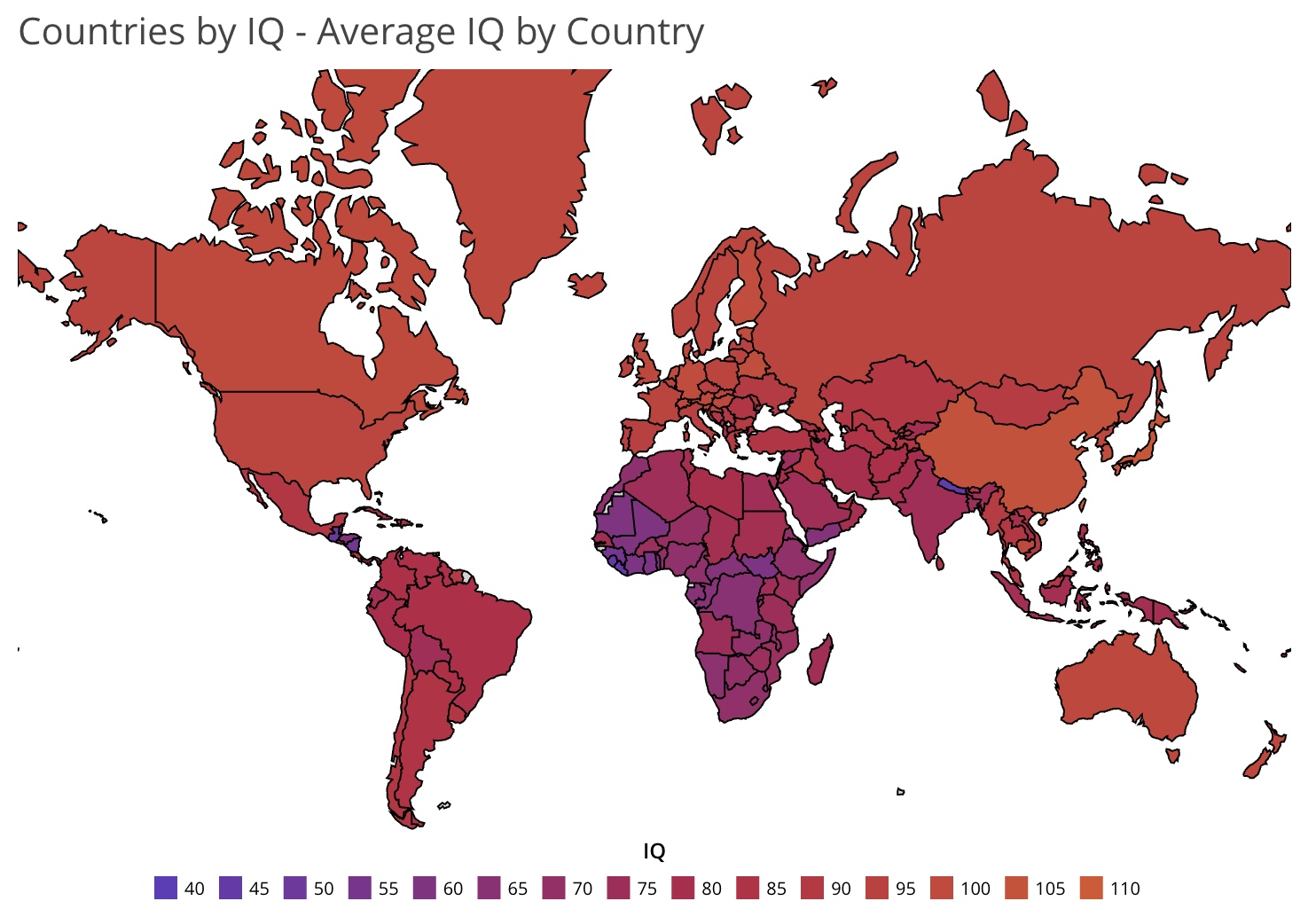
The number actually represents how your results compare to those of other people your age. A score of 116 or more is considered above average. A score of 130 or higher signals a high IQ. Membership in Mensa, the High IQ society, includes people who score in the top 2 percent, which is usually 132 or higher.
Leia mais
IQ tests are made to have an average score of 100. Psychologists revise the test every few years in order to maintain 100 as the average. Most people (about 68 percent) have an IQ between 85 and 115. Only a small fraction of people have a very low IQ (below 70) or a very high IQ (above 130).United Kingdom – 64.19 (A) Germany – 64.18 (A) Australia – 63.96 (A) Singapore – 63.60 (A)

What is the IQ in Brazil
It is estimated that the mean IQ in Brazil is 87.8. The mean IQs of the four principal racial and ethnic groups are estimated as whites, 95; "browns", 81; blacks, 71; and Asians, 99. These IQs are calculated in relation to a British mean of 100. Discover the world's research. 700k+ research projects Join for free.
An individual's IQ does not change with age. In other words: if you did an IQ test now and then another one in 10 years' time, your IQ score will probably be very similar. This is because IQ is always measured relative to other people your age.The cause of the IQ decline is due to environmental factors, and not genetics, said Ole Rogeburg, a senior research fellow at Ragnar Frisch Centre and co-author of the study on IQ scores, published in the Proceedings of the National Academy of Sciences journal.An individual's IQ does not change with age. In other words: if you did an IQ test now and then another one in 10 years' time, your IQ score will probably be very similar. This is because IQ is always measured relative to other people your age.

Intelligence related to income and climate
| Rank | Country | IQ |
|---|---|---|
| 80 | Pakistan | 82 |
| 81 | Peru | 82 |
| 82 | India | 81 |
| 83 | Saudi Arabia | 81 |
What is the lowest IQ score
0/200
The lowest IQ score is 0/200, but nobody in recorded history has officially scored 0. Any result below 75 points is an indicator of some form of mental or cognitive impairment.
Parents tend to search “What is the average IQ for a 13-year-old” or “What is the average IQ for a 10-year-old”. The key point to remember is that all tests are designed to get an average score of 100 for people of all ages. Current average IQ scores vary between 85 and 115 (about 68% of people).
Researchers have previously shown that a person's IQ is highly influenced by genetic factors, and have even identified certain genes that play a role. They've also shown that performance in school has genetic factors. But it's been unclear whether the same genes that influence IQ also influence grades and test scores.
Leia mais

An individual's IQ does not change with age. In other words: if you did an IQ test now and then another one in 10 years' time, your IQ score will probably be very similar. This is because IQ is always measured relative to other people your age.In addition to slowing down physically, most people lose points on intelligence tests as they enter their golden years. Now, new research suggests the loss of certain types of cognitive skills with age may stem from problems with basic sensory tasks, such as making quick judgments based on visual information.The IQ score can be calculated with the formula of IQ = (intelligence age/actual age) x100. Here is a short list of the most common IQ tests (intelligence quotient test), other than MentalUP's online IQ test that you or your children may want to take: Stanford-Binet (SB-V) Wechsler Adult Intelligence Scale (WAIS-IV)However, the lowest IQ score possible is zero. Can someone actually get this low of a score In theory, yes. But no one in recorded history has officially scored zero on an IQ test, even if that result is theoretically attainable.

Training your memory, executive control, and visuospatial reasoning can help to boost your intelligence levels. The best way to train these areas of your brain is to engage in thoughtful activities and games, learn new skills, and keep your brain active.Training your memory, executive control, and visuospatial reasoning can help to boost your intelligence levels. The best way to train these areas of your brain is to engage in thoughtful activities and games, learn new skills, and keep your brain active.mental age, intelligence test score, expressed as the chronological age for which a given level of performance is average or typical. An individual's mental age is then divided by his chronological age and multiplied by 100, yielding an intelligence quotient (IQ).Training your memory, executive control, and visuospatial reasoning can help to boost your intelligence levels. The best way to train these areas of your brain is to engage in thoughtful activities and games, learn new skills, and keep your brain active.

An average person scores 100 on an IQ test using the Stanford-Binet IQ scale. A score of 137 to 160 is considered the top 1 percent to . 01 percent of all scorers. Frank Lawlis, director of psychological testing for American Mensa, also joined the discussion on The Daily Circuit.An individual's IQ does not change with age. In other words: if you did an IQ test now and then another one in 10 years' time, your IQ score will probably be very similar. This is because IQ is always measured relative to other people your age.The average child's IQ is not stable until around four years of age. It may be much later in children who were born early or who have significant health issues.Researchers have found that IQ can rise or fall during the teen years and that the brain's structure reflects this uptick or decline. The result offers the first direct evidence that intelligence can change after early childhood and provides new hope for boosting the brain's abilities.

A percentile score of 99% means that you are in the top 1%, a percentile score of 98% puts you in the top 2% and so on. Mensa membership is offered to anyone who can demonstrate an IQ in the top two per cent from any recognised IQ test.Although science is on the fence about whether you can raise your IQ or not, research does seem to suggest that it's possible to raise your intelligence through certain brain-training activities. Training your memory, executive control, and visuospatial reasoning can help to boost your intelligence levels.